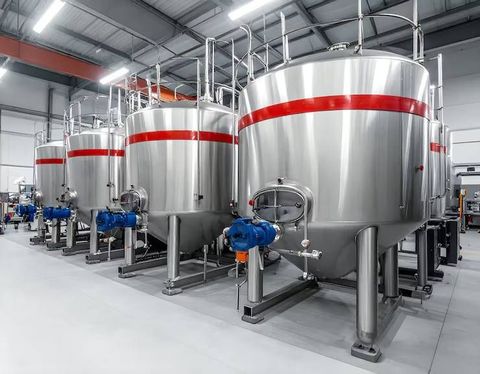
Industrial Water Pump: Guide to Types, Uses, and Working Principles
An industrial water pump is a mechanical device designed to move water from one location to another within industrial, commercial, agricultural, and infrastructure systems.
Pumps exist because water often needs to travel through pipes, tanks, treatment systems, cooling circuits, or elevated areas where natural flow is not sufficient.
The basic principle is straightforward: a pump transfers mechanical energy into water, creating movement through a piping system. Depending on the design, a pump may create pressure, increase flow, lift water to a higher level, or maintain circulation through a closed system.
Industrial water pump systems can be found in manufacturing plants, water treatment facilities, power generation facilities, construction projects, irrigation networks, and building infrastructure. Their design varies according to water quality, flow requirements, pressure, temperature, operating conditions, and the distance water must travel.
How an industrial water pump works
Most pumps use an electric motor, engine, or another mechanical power source to drive internal components. In a centrifugal pump, a rotating impeller accelerates water outward, converting rotational energy into fluid movement and pressure.
Positive displacement pumps work differently. They move a defined quantity of fluid during each operating cycle. These pumps are commonly associated with situations requiring controlled flow or higher pressure.
A basic pumping system generally includes:
- Water source or collection point
- Pump and driving mechanism
- Inlet and outlet piping
- Valves and flow-control components
- Pressure or flow measurement equipment
- Storage, treatment, or distribution equipment
The correct combination depends on the characteristics of the application.
Importance
Industrial water pumps matter because reliable water movement is part of many processes that support modern infrastructure. Water may be required for cooling, cleaning, processing, circulation, irrigation, fire protection, drainage, or treatment.
A suitable pumping arrangement helps maintain the required movement of water through a system. Poorly matched equipment can result in insufficient flow, excessive pressure, inefficient operation, vibration, or premature component wear.
Common industrial uses
An industrial water pump can be used in several areas:
- Water treatment: Moving raw, filtered, or treated water between process stages.
- Manufacturing: Circulating water for cooling, washing, or production processes.
- Agriculture: Moving water through irrigation networks and storage systems.
- Construction: Removing accumulated water from excavation areas or transferring water between temporary tanks.
- Buildings: Supporting water circulation, pressure boosting, and other infrastructure functions.
- Energy facilities: Circulating water for cooling and related processes.
- Wastewater systems: Moving water through collection, treatment, and discharge stages.
The characteristics of the water also matter. Clean water and water containing suspended solids may require different pump designs because particles can affect internal components and flow passages.
Main pump types
Several pump categories are used in industrial environments. Their differences mainly relate to how they move water and the conditions they are designed to handle.
| Pump type | Basic working principle | Common applications |
|---|---|---|
| Centrifugal | Rotating impeller transfers energy to water | General water circulation and transfer |
| Submersible | Motor and pump operate while submerged | Drainage and deep-water applications |
| Diaphragm | Flexible diaphragm moves fluid through cycles | Controlled transfer and difficult fluids |
| Piston | Reciprocating piston displaces fluid | High-pressure applications |
| Gear | Rotating gears move a measured fluid volume | Controlled fluid movement |
| Axial-flow | Propeller produces movement mainly along the shaft | High-flow, lower-pressure applications |
Centrifugal pumps are widely used because their operating principle is relatively simple and suitable for many water-transfer situations. Submersible pumps are placed directly in the liquid, which can make them useful where water must be removed from wells, pits, drainage areas, or tanks.
Positive displacement designs, such as piston, diaphragm, and gear pumps, move fluid through repeated displacement cycles. Their characteristics can make them suitable for applications where flow control or pressure requirements differ from those of conventional centrifugal systems.
Factors that influence pump selection
Pump selection involves more than choosing a pump based on pipe size. Important factors include:
- Required flow rate
- Required pressure or head
- Water temperature
- Water cleanliness and particle content
- Pipe length and diameter
- Vertical lifting distance
- Operating frequency
- Motor or power requirements
- Material compatibility
- Installation environment
The term “head” describes the energy required to move water through a system and is commonly expressed as a height of water. Understanding both flow and head is important when evaluating how a pump will behave within a particular piping arrangement.
Recent Updates
Current developments in industrial pumping increasingly focus on energy management, monitoring, automation, and equipment efficiency. Digital sensors can measure variables such as pressure, flow, temperature, vibration, and motor performance, allowing operators to observe system conditions more closely.
Variable-frequency drives are also widely associated with modern pumping systems. They can adjust motor speed according to changing system requirements, rather than operating at one fixed speed in every situation. This can be useful in systems where demand changes throughout the operating cycle.
Digital monitoring and control
Modern industrial facilities increasingly integrate pumps with control systems. Sensors and connected monitoring equipment can provide information about operating conditions and help identify unusual vibration, temperature changes, pressure variation, or flow behavior.
Another continuing trend is predictive maintenance. Instead of relying only on fixed inspection intervals, operators can use measured operating data to identify changes that may indicate developing mechanical or hydraulic problems.
Material development is also relevant. Pump components may be selected according to exposure to corrosion, abrasion, temperature, or suspended particles. The appropriate material depends on the characteristics of the water and the operating environment.
Tools and Resources
Several resources can help readers understand or evaluate industrial pumping systems. Manufacturer-neutral pump sizing calculators can demonstrate how flow rate, head, pipe dimensions, and system resistance interact. Hydraulic calculation tools can also help estimate pressure losses through pipes, valves, bends, and other components.
Useful resources include:
- Pump sizing calculators for estimating flow and head requirements
- Hydraulic tables for pipe-flow calculations
- Engineering unit converters for pressure, flow, and head measurements
- Pump curves showing relationships between flow, head, and efficiency
- Maintenance checklists for recording operating conditions
- Digital monitoring platforms for tracking pressure, temperature, vibration, and flow
- Technical standards and engineering references for system design
Pump curves are particularly useful because they show how a pump is expected to perform under different operating conditions. The actual operating point depends on the interaction between the pump curve and the resistance of the connected piping system.
FAQs
What is an industrial water pump?
An industrial water pump is equipment used to move water through pipes, tanks, treatment systems, cooling systems, drainage networks, and other industrial installations. Different pump designs are selected according to flow, pressure, water characteristics, and operating conditions.
How does an industrial water pump work?
An industrial water pump transfers mechanical energy to water. Centrifugal designs use a rotating impeller, while positive displacement designs move defined quantities of fluid through repeated mechanical cycles.
What are the main types of industrial water pumps?
Common types include centrifugal, submersible, diaphragm, piston, gear, and axial-flow pumps. Each type has different hydraulic characteristics and is suited to particular operating conditions.
How is an industrial water pump selected?
Selection generally considers flow rate, head, pipe arrangement, water temperature, fluid cleanliness, particle content, operating frequency, power requirements, and material compatibility.
Why are pump curves important?
Pump curves show the relationship between flow, head, and other performance characteristics. They help engineers and operators understand how a pump may perform when connected to a particular piping system.
Conclusion
Industrial water pumps are important components in systems that move, circulate, lift, or transfer water. Centrifugal and positive displacement designs use different principles, making each suitable for different hydraulic conditions. Modern pumping systems increasingly incorporate sensors, variable-speed control, and digital monitoring to improve operational awareness. Understanding flow, head, water characteristics, and system resistance provides a useful foundation for understanding how industrial pumping equipment functions.

Related Post...
Leak Prevention Guide to Common Causes, Detection Methods, and Risk Reduction
Updated: October 23, 2026
Read More
Structural Steel Contractors Knowledge of Materials, Connections, and Safety Practices
Updated: October 23, 2026
Read More
Refrigeration Control Systems Guide for Understanding Cooling Regulation
Updated: October 19, 2026
Read More