Industrial Machinery Parts Insights: Learn About Equipment Components
Industrial machinery parts are the individual components that allow machines to perform specific mechanical tasks.
These parts can include gears, bearings, shafts, belts, chains, couplings, seals, fasteners, valves, electrical components, and structural elements. Together, they form larger equipment used in manufacturing, construction, agriculture, transportation, energy production, and material handling.
Industrial machinery parts exist because complex equipment needs many coordinated components to convert energy into controlled movement or other useful functions. A large machine may contain hundreds or thousands of individual parts, with each component designed for a particular role.
How Equipment Components Work Together
Different components interact to create a complete mechanical system. For example, a motor can provide rotational movement, while a shaft transfers that movement to another part of the machine. Gears can alter speed or direction, while bearings help support rotating elements and reduce friction.
Common industrial machinery parts include:
- Gears for transferring motion and changing rotational speed or direction
- Bearings for supporting moving shafts and reducing friction
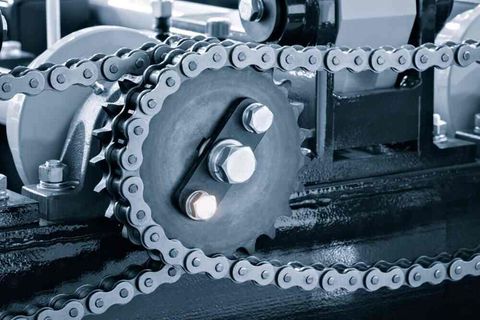
- Belts and chains for transferring movement between components
- Seals and gaskets for helping prevent fluid or lubricant leakage
- Fasteners for connecting structural and mechanical elements
- Valves for controlling the movement of liquids or gases
- Electrical components for controlling power and machine functions
The exact combination depends on the machine's purpose, operating environment, load, speed, temperature, and material requirements.
Materials Used in Machinery Components
Equipment components can be produced from metals, polymers, ceramics, composites, and other engineered materials. Steel and stainless steel are common in applications that require strength and durability, while aluminum can be used where lower weight is useful.
Material selection depends on factors such as mechanical load, corrosion exposure, operating temperature, friction, vibration, and contact with chemicals. Understanding these factors helps explain why two visually similar components may have different material specifications.
Importance
Why Machinery Components Matter
Industrial machinery parts affect how equipment operates, moves, transfers force, and handles materials. A damaged or incorrectly fitted component can influence the performance of a larger machine because industrial equipment generally functions as an interconnected system.
For general users, understanding equipment components can make technical information easier to interpret. Machine manuals, diagrams, maintenance records, and component specifications often use specific names that may be unfamiliar without basic knowledge of machinery.
Maintenance and Component Condition
Regular inspection helps identify visible signs of component wear, contamination, deformation, corrosion, or abnormal movement. Some parts naturally experience greater mechanical stress than others because they carry loads or remain in continuous motion.
Common factors that can affect component condition include:
- Repeated mechanical loads
- Excessive vibration
- High or low operating temperatures
- Moisture and corrosive environments
- Dust and other contaminants
- Incorrect alignment
- Inadequate lubrication
- Improper installation
The useful life of a component varies according to its design, operating conditions, material, workload, and maintenance practices. Manufacturer specifications and equipment documentation generally provide the relevant technical limits.
Safety and Operational Considerations
Industrial equipment can involve moving mechanisms, electrical power, pressure, heat, and heavy loads. Components such as guards, fasteners, bearings, seals, switches, and structural supports can therefore have roles that extend beyond ordinary machine operation.
Component identification should be based on equipment documentation, technical drawings, identification markings, or qualified technical assessment when safety is involved. General information alone may not be sufficient for determining whether a particular component is appropriate for a specific machine.
Recent Updates
Developments in Industrial Machinery Parts
From 2024 through 2026, industrial machinery has continued to move toward greater monitoring, automation, and data-based maintenance practices. Sensors and connected control systems are increasingly used to collect information about temperature, vibration, pressure, rotation, and other operating conditions.
This development has increased attention on components that can be monitored through digital systems. Bearings, motors, pumps, gearboxes, and other mechanical assemblies may be evaluated using sensor information to identify changes in operating behavior.
Digital Identification and Inventory Management
Digital records are also becoming more important for industrial machinery parts. Electronic catalogs, component databases, QR codes, and digital equipment records can help organizations identify components and maintain consistent information about specifications.
Computerized inventory systems can record component descriptions, identification numbers, equipment relationships, and replacement history. This can make it easier to distinguish between visually similar components with different technical specifications.
Condition Monitoring and Predictive Maintenance
Condition monitoring has continued to develop as industrial facilities collect more equipment data. Instead of relying only on fixed inspection intervals, some systems analyze information such as vibration patterns, temperature changes, and operating hours.
Predictive maintenance does not eliminate the need for physical inspection. Rather, it adds another source of information that can help technical teams understand equipment condition and investigate unusual operating patterns.
Materials and Manufacturing Trends
Manufacturing methods for machinery components are also evolving. Computer-controlled machining, additive manufacturing, improved surface treatments, and advanced material development are being applied to selected industrial applications.
These developments can support more precise component production and specialized designs. However, the suitability of a manufacturing method still depends on the component's intended function, material requirements, dimensional tolerances, and operating environment.
Tools and Resources
Component Catalogs and Technical Documents
Manufacturer catalogs, technical drawings, equipment manuals, and parts diagrams are useful resources for understanding industrial machinery parts. They commonly provide component names, dimensions, material information, identification numbers, and assembly relationships.
Measurement Tools
Basic measurement tools can help with general component identification and inspection. Common examples include:
- Digital calipers for measuring external and internal dimensions
- Micrometers for more precise dimensional measurements
- Feeler gauges for checking small gaps
- Torque tools for controlled fastening
- Vibration meters for monitoring mechanical movement
Measurement results should be interpreted according to the applicable equipment specifications rather than by dimensions alone.
Digital Maintenance Platforms
Computerized maintenance management systems and asset-management platforms can organize equipment records, inspection information, component histories, and maintenance schedules. Digital documentation can provide a clearer connection between individual components and the machines in which they are installed.
Reference Standards and Technical Resources
Engineering standards organizations, equipment documentation portals, technical libraries, and manufacturer reference materials can provide additional information about dimensions, materials, tolerances, safety requirements, and testing methods. The relevant reference depends on the machinery type and industry.
FAQs
What are industrial machinery parts?
Industrial machinery parts are individual components used to construct and operate industrial equipment. Examples include gears, bearings, shafts, belts, seals, valves, fasteners, and electrical components.
Why are equipment components important?
Equipment components perform specific mechanical, structural, electrical, or control functions. Their interaction allows larger machines to transfer motion, handle loads, control materials, and perform intended processes.
How can industrial machinery parts be identified?
Components can often be identified through equipment manuals, technical drawings, identification markings, dimensions, photographs, and component catalogs. Identification should consider the complete specification rather than appearance alone.
What affects the condition of equipment components?
Load, vibration, temperature, contamination, corrosion, lubrication, alignment, installation, and operating conditions can all affect component condition. Different parts are affected differently depending on their design and function.
How is technology changing industrial machinery parts management?
Digital catalogs, sensors, condition-monitoring systems, and maintenance platforms are making component records and equipment data more accessible. These technologies can support tracking, inspection, and analysis of machinery condition.
Conclusion
Industrial machinery parts are the individual elements that work together to create functional industrial equipment. Gears, bearings, shafts, seals, fasteners, electrical components, and other parts each have specific roles within a larger system. Developments from 2024 through 2026 have placed greater emphasis on digital records, condition monitoring, connected equipment, and advanced manufacturing methods. Understanding these components provides useful context for interpreting machinery documentation, maintenance information, and equipment specifications.

Related Post...
Industrial Screws Basics: Explore Common Types and Manufacturing Features
Updated: September 16, 2026
Read More
Hotel Booking Platform Overview: Key Features of Modern Hotel Reservation Platforms
Updated: September 16, 2026
Read More
Heat Transfer Printing Machines: Technology, Process, and Practical Insights
Updated: September 16, 2026
Read More