Industrial Shredding Insights: Understanding Systems, Components, and Material Reduction
Industrial shredding is a mechanical process used to reduce large, bulky, or difficult materials into smaller pieces.
Industrial shredding systems are found in recycling plants, manufacturing facilities, waste-processing operations, and material recovery environments. The main purpose is to make materials easier to handle, transport, sort, process, or prepare for another production stage.
Unlike household shredders designed for paper or small items, industrial systems are built around larger feed openings, stronger cutting mechanisms, powerful drives, and control systems. Their design varies according to the material being processed, the required output size, and the expected operating conditions.
How Material Reduction Works
Material reduction generally begins when an input material enters a feed hopper or conveyor. Rotating shafts, cutters, knives, hooks, or other cutting elements apply mechanical force until the material breaks into smaller pieces.
The resulting size depends on several factors, including cutter geometry, rotor speed, cutting gap, material characteristics, and screen configuration. Some systems perform a single shredding stage, while others use several stages to reach a more controlled particle size.
Common materials processed through industrial shredding include:
- Plastics and polymer waste
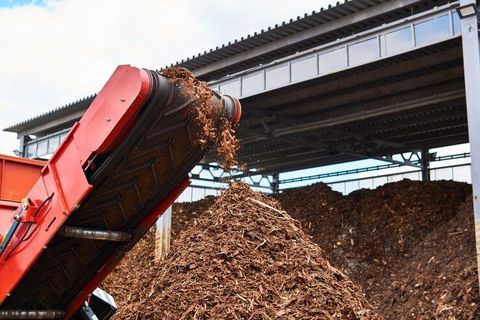
- Wood and biomass
- Paper and cardboard
- Rubber and tires
- Textile materials
- Construction and demolition materials
- Industrial production residues
- Scrap metal
- Mixed solid waste
The system selected for one material may not be suitable for another because hardness, moisture, density, flexibility, and contamination can significantly affect shredding behavior.
Importance
Why Industrial Shredding Matters
Industrial shredding plays an important role in material management because reducing the physical size of waste or production residues can simplify later handling. Smaller and more uniform pieces can move more easily through conveyors, sorting equipment, granulators, separators, and other processing stages.
Shredding can also help prepare materials for recycling and recovery. For example, scrap materials may be reduced before separation, while plastics can be prepared for further size reduction or processing. In some facilities, shredded materials are also used as feedstock for subsequent recovery or conversion processes.
Components of a Shredding System
An industrial shredding system normally contains several connected components rather than a single machine. Each part contributes to controlled material reduction.
The main components commonly include:
- Feed hopper: Receives incoming material and directs it toward the cutting area.
- Rotor or shafts: Carry the cutting elements and create the mechanical movement required for shredding.
- Knives or cutters: Contact and break the incoming material.
- Drive system: Supplies rotational power through an electric motor, gearbox, hydraulic arrangement, or other drive configuration.
- Screen: Controls the size of material leaving certain types of shredders.
- Conveyor: Moves input or processed material between different stages.
- Control system: Monitors operating conditions and manages functions such as speed, direction, load response, and protective shutdowns.
The interaction between these components determines how consistently a system handles its intended material.
Types of Industrial Shredders
Different industrial shredders use different cutting arrangements. Single-shaft shredders commonly use a rotating rotor and stationary counter-cutters, while twin-shaft systems use two rotating shafts that pull and tear material between their cutting elements.
Four-shaft designs can provide additional stages of cutting and size control. Hammer-based systems use rapidly moving elements to break materials through impact and mechanical force. The choice depends on the material, desired output, throughput requirements, and the overall processing line.
Recent Updates
Automation and Digital Monitoring
From 2024 through 2026, industrial shredding technology has continued moving toward greater automation, monitoring, and process control. Research published in 2025 examined digital approaches for forecasting shredder output flow, showing continued interest in using data to support dynamic control of waste-processing systems.
Modern control systems can monitor variables such as motor load, rotor behavior, temperature, and operating conditions. This information can help operators identify unusual conditions and adjust processing parameters when appropriate.
Energy-Efficient Drive Technology
Energy management has also received increasing attention. In 2025, equipment developments included more efficient electric drive concepts and variable-speed technologies designed to adjust machine behavior according to processing conditions. For example, a 2025 development for a single-shaft plastic shredder highlighted a synchronous-reluctance drive and an adjustable rotor arrangement.
Large metal-recycling projects have also incorporated variable-frequency drive technology to manage power demand and rotor speed during changing scrap loads. A 2025 project in Maharashtra, India, included variable-speed drive technology alongside continuous feeding and downstream separation.
Integration With Sorting and Recovery
Another current trend is closer integration between shredding, sorting, separation, and material recovery. Instead of treating the shredder as an isolated machine, modern processing lines increasingly connect it with conveyors, sensors, separators, and automated controls.
This approach is particularly relevant for mixed waste streams where the final objective involves separating different material fractions. The broader direction is toward connected processing systems in which shredding is one stage within a larger material-recovery workflow.
| System element | Main function | Typical consideration |
|---|---|---|
| Feed hopper | Introduces material | Input dimensions and consistency |
| Rotor or shafts | Creates cutting movement | Speed and torque |
| Cutters | Break material | Material hardness and cutter design |
| Screen | Controls output size | Desired particle dimensions |
| Drive system | Provides mechanical power | Load response and energy use |
| Conveyor | Transfers material | Flow rate and layout |
| Control system | Monitors operation | Sensors, automation, and protection |
Tools and Resources
Equipment Documentation
Manufacturer technical manuals, operating guides, and equipment specifications can help readers understand shredder configurations, component terminology, and operating principles. Technical documentation is particularly useful when comparing single-shaft, twin-shaft, and multi-stage arrangements.
Material-Reduction Calculators
Engineering and recycling calculators can be used to estimate material volume, bulk density, throughput, and conveyor capacity. These calculations help explain how changes in material characteristics can influence the design of a processing line.
Recycling and Waste Resources
Government environmental agencies, recycling associations, and waste-management organizations publish educational material about waste classification, recycling processes, and material recovery. These resources provide useful background when studying how industrial shredding fits into broader waste-management systems.
Process Monitoring Tools
Industrial control platforms can collect information from motors, sensors, conveyors, and shredding equipment. Depending on the installation, dashboards may display operating load, temperature, machine status, production data, and alerts. These tools are increasingly connected with automation systems to support more consistent process monitoring.
FAQs
What is industrial shredding?
Industrial shredding is a mechanical material-reduction process that breaks large or bulky materials into smaller pieces. It is commonly used in recycling, waste processing, manufacturing, and material recovery.
How do industrial shredding systems work?
Industrial shredding systems feed material toward rotating cutters, shafts, or other mechanical elements. The material is subjected to cutting, tearing, compression, or impact until it reaches the required degree of reduction.
What components are found in industrial shredding systems?
Common components include feed hoppers, rotors or shafts, cutting elements, drive systems, screens, conveyors, and control systems. The exact configuration depends on the material and processing requirements.
Why is material reduction important?
Material reduction can make bulky materials easier to transport, sort, separate, and process. It can also prepare materials for subsequent recycling or recovery stages.
What are recent industrial shredding trends?
Recent trends include increased automation, digital monitoring, variable-speed drives, energy-focused motor technology, and integration with sorting and separation equipment. Developments reported during 2024–2026 show continued attention to connected and adaptable processing systems.
Conclusion
Industrial shredding is a material-reduction process that supports recycling, waste processing, manufacturing, and resource recovery. Its performance depends on the relationship between cutters, shafts, drives, screens, conveyors, and control systems. Recent developments from 2024 through 2026 show increasing attention to automation, digital monitoring, energy management, and integrated processing lines. Understanding these systems provides useful context for explaining how different materials move from large or mixed inputs toward more manageable output streams.

Related Post...
Guide to Chain & Sprocket Manufacturing Machines and Production Processes
Updated: September 18, 2026
Read More
Industrial Water Pump Overview: Facts, Basics, and Useful Tips
Updated: September 18, 2026
Read More
Ocean Freight Forwarding & Port Logistics: Essential Knowledge and Facts
Updated: September 13, 2026
Read More