Palm Oil Production: An Overview of Farming, Processing, and Key Facts
Palm oil production covers the cultivation of oil palm trees, harvesting of fresh fruit bunches, extraction of crude palm oil, and further processing into ingredients used in foods, personal care products, oleochemicals, and other goods.
Oil palm is native to West Africa, while large-scale cultivation is now concentrated in tropical parts of Southeast Asia, especially Indonesia and Malaysia. Understanding the full chain helps explain how palm oil moves from farms to processing facilities and why environmental and social questions remain part of the discussion.
Context
From palm fruit to usable oil
The main commercial oil palm species is Elaeis guineensis. It grows in warm, humid climates and produces fruit bunches containing two useful oils: palm oil from the fleshy fruit and palm kernel oil from the seed. A plantation may contain trees of different ages, with harvesting carried out repeatedly as bunches mature.
Palm oil production begins with land preparation and planting, followed by several years of growth before meaningful harvests. Farmers monitor weeds, nutrients, pests, water conditions, and fruit maturity. Mature bunches are cut and transported to a mill, where processing needs to begin relatively soon after harvest to limit deterioration in fruit quality.
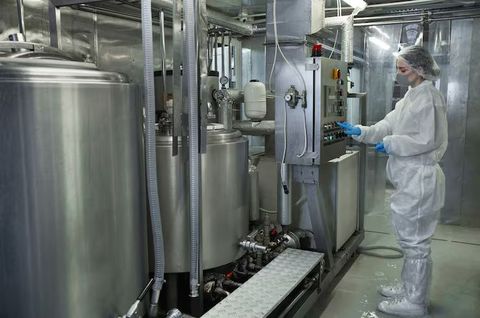
At the mill, bunches are sterilized with steam, threshed to separate fruit from bunches, and pressed to extract crude palm oil. The kernels are recovered separately and processed for palm kernel oil. The crude oils can then undergo refining, bleaching, and deodorization, followed by fractionation or other processing depending on their intended use.
Main stages in palm oil production
| Stage | Main activity | Typical output |
|---|---|---|
| Cultivation | Tree growth and field management | Mature oil palm fruit |
| Harvesting | Cutting ripe fruit bunches | Fresh fruit bunches |
| Milling | Sterilizing, threshing, digesting, and pressing | Crude palm oil and kernels |
| Kernel processing | Cracking and pressing kernels | Palm kernel oil |
| Refining | Removing impurities and unwanted compounds | Refined palm oil fractions |
| Manufacturing | Using oils in food and industrial formulations | Finished ingredients or products |
Palm oil is widely used because its chemical and physical properties make it suitable for many applications. It can provide texture in foods, stability in some formulations, and useful raw materials for oleochemical processing.
Importance
Why palm oil matters
Palm oil production affects farmers, plantation workers, mill operators, manufacturers, consumers, and communities in tropical growing regions. Smallholders are an important part of the sector in several producing countries, while larger plantations and mills also contribute substantial volumes.
The crop also matters because oil palms can produce a relatively high amount of vegetable oil per unit of cultivated land compared with several other common oil crops. However, productivity alone does not determine environmental impact. How land is acquired, what vegetation existed before planting, how water and soil are managed, and how waste is handled all influence the overall picture.
Environmental concerns are especially associated with forest conversion, peatland disturbance, biodiversity loss, greenhouse gas emissions, and pollution from poorly managed processing waste. Social issues can include land rights, labor conditions, smallholder inclusion, and relationships between plantations and nearby communities.
Responsible production therefore involves several connected areas:
- Land-use planning that avoids inappropriate conversion of forests and high-value habitats.
- Soil and water management that reduces erosion and protects waterways.
- Nutrient and pest management based on field conditions.
- Recovery or treatment of mill residues and wastewater.
- Traceability systems that help identify where palm-based materials originate.
- Respect for legal requirements, labor rights, and community interests.
Recent Updates
Changes in standards and traceability
From 2024 through 2026, sustainability standards and supply-chain traceability have continued to develop. The Roundtable on Sustainable Palm Oil adopted revised Principles and Criteria and an Independent Smallholder Standard in late 2024. The revised standards became applicable to relevant certification processes from late 2025.
Certification systems were also revised during this period. RSPO states that its 2025 Certification Systems for the Principles and Criteria and Independent Smallholder Standard became effective in May 2026, creating a new framework for audits and implementation.
Supply-chain verification remains an active area of development. RSPO began a review of its Supply Chain Certification Standard in 2025, with public consultation on a revised draft taking place during 2026. The review focuses on clarity, relevance, auditability, and practical implementation across supply chains.
For general readers, these developments show a wider shift toward documenting production practices and tracing palm-based materials through more stages of the supply chain. They do not mean that every palm oil producer follows the same standard; certification remains dependent on the applicable scheme and verification process.
Tools and Resources
Useful ways to learn and assess information
Several resources can help readers understand palm oil production without relying on promotional material. The RSPO standards library provides documents covering principles, smallholder requirements, certification systems, and supply-chain controls. Its materials are useful for understanding how voluntary sustainability standards are structured.
Government agriculture agencies and international organizations also publish crop statistics, production estimates, land-use information, and agricultural guidance. Readers comparing figures should check the reporting year, geographic scope, measurement unit, and whether a figure refers to crude palm oil, palm kernel oil, or total oil production.
For basic farm or processing analysis, useful tools include:
- Yield calculators for comparing output per hectare.
- Unit converters for tonnes, kilograms, hectares, and related measurements.
- Supply-chain maps for understanding movement from plantations to mills and refineries.
- Sustainability standards and audit documents for reviewing environmental and social criteria.
- Agricultural records for tracking planting age, harvest volumes, field inputs, and mill throughput.
These resources provide context, but figures from different sources may not be directly comparable because definitions and data collection methods can differ.
FAQs
What is palm oil production?
Palm oil production is the process of growing oil palm, harvesting its fruit, extracting oil at a mill, and refining or processing the resulting materials for later use. It includes agricultural, milling, refining, and manufacturing stages.
Where does palm oil production mainly take place?
Large-scale palm oil production is concentrated in tropical regions, particularly Indonesia and Malaysia. Oil palm is also cultivated in parts of Africa, Latin America, and other tropical areas.
How is palm oil production different from palm kernel oil production?
Palm oil comes mainly from the fleshy part of the oil palm fruit, while palm kernel oil comes from the seed inside the fruit. Their chemical properties and common uses differ.
Why is sustainability important in palm oil production?
Sustainability matters because cultivation and processing can affect forests, biodiversity, soil, water, greenhouse gas emissions, workers, farmers, and nearby communities. Standards and traceability systems are intended to help address some of these concerns.
What happens to waste during palm oil production?
Mills generate materials such as empty fruit bunches, fibers, shells, and wastewater. Depending on the facility, these materials may be used for energy, returned to fields, processed into other materials, or treated through wastewater management systems.
Conclusion
Palm oil production connects tropical agriculture with milling, refining, and a wide range of manufacturing activities. Its importance comes with environmental, economic, and social considerations that vary by location and production method. Recent changes in sustainability standards and traceability show continued attention to how palm-based materials are produced and documented. Understanding each stage of the chain provides a clearer view of both the practical uses of palm oil and the challenges surrounding its production.

Related Post...

Industrial Water Purify: Discover Essential Facts About Purification Methods
Updated: September 11, 2026
Read More
Palm Oil Production: An Overview of Farming, Processing, and Key Facts
Updated: September 13, 2026
Read More
International Air Cargo Logistics: Essential Basics for Global Shipping
Updated: September 13, 2026
Read More